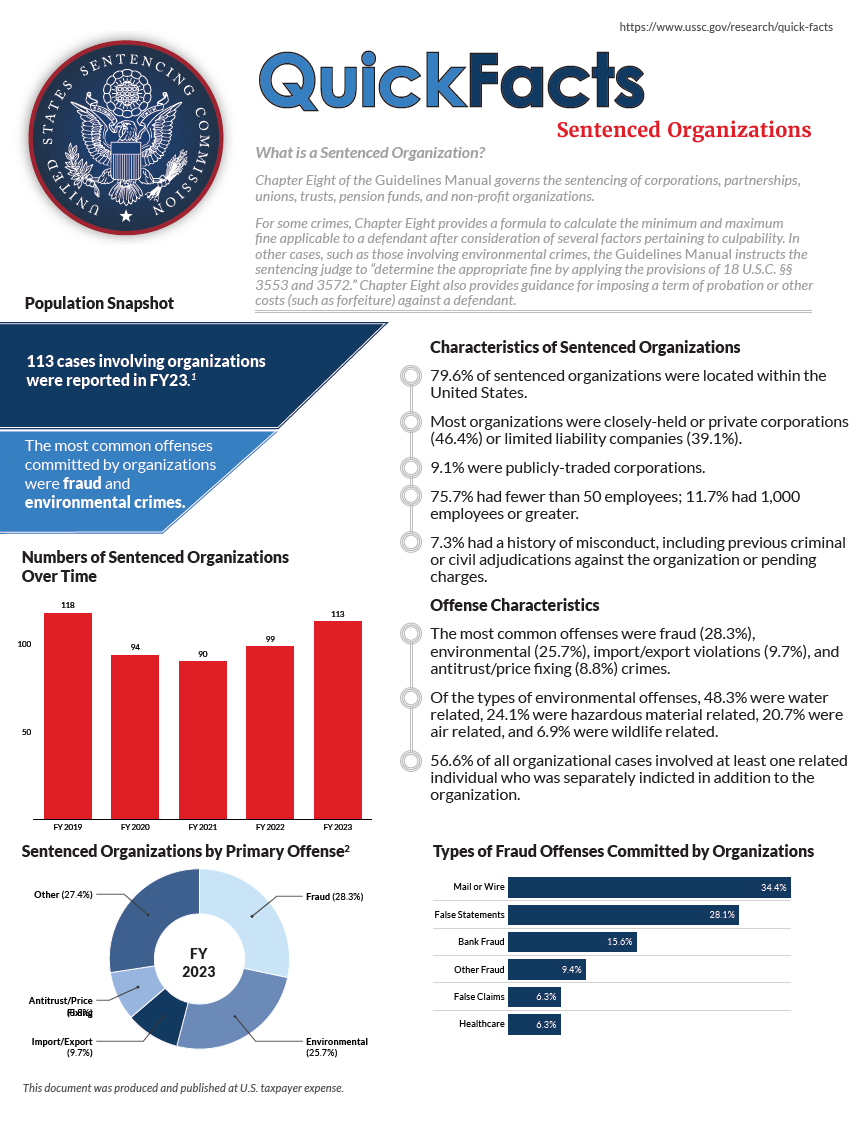
In fiscal year 2025, 110 cases were reported to the Commission that involved sentenced organizations. The most common offenses committed by organizations were environmental crimes and fraud.1
Click the cover for the PDF handout or learn more below.
What is a Sentenced Organization?
Chapter Eight of the Guidelines Manual governs the sentencing of corporations, partnerships, unions, trusts, pension funds, and non-profit organizations.
For some crimes, Chapter Eight provides a formula to calculate the minimum and maximum fine applicable to a defendant after consideration of several factors pertaining to culpability. In other cases, such as those involving environmental crimes, the Guidelines Manual instructs the sentencing judge to “determine the appropriate fine by applying the provisions of 18 U.S.C. §§ 3553 and 3572.” Chapter Eight also provides guidance for imposing a term of probation or other costs (such as forfeiture) against a defendant.

Characteristics of Sentenced Organizations
- 78% of sentenced organizations were located within the United States.
- Most organizations were closely-held or private corporations (53%) or limited liability companies (37%).
- 7% were publicly-traded corporations.
- 2% were sole proprietorships.
- 1% were associations.
- 66% had fewer than 50 employees; 19% had 1,000 employees or greater.
- 8% had a history of misconduct, including previous criminal or civil adjudications against the organization or pending charges.
Offense Characteristics


- The most common offenses were environmental (37%), fraud (23%), money laundering (13%), antitrust/price fixing (5%), food & drugs (5%) and import/export violations (5%).
- Of the types of environmental offenses, 51% were air related, 32% were water related, 12% were hazardous material related, and 5% were wildlife related.
- 62% of all organizational cases involved at least one related individual who was separately indicted in addition to the organization.

Chapter Eight Application
- 33% of the 110 sentenced organizations were sentenced pursuant to the Chapter Eight fine provisions (found in USSG §§8C2.1-8C2.9). The remaining organizations were sentenced pursuant to §8C2.10.
- Of the 36 organizations sentenced under §§8C2.1-8C2.9:
- 24 organizations (67%) received one or more points under §8C2.5(b) because they had at least ten employees and had a person in substantial authority who participated, condoned, or was willfully ignorant of the offense.
- Two organizations (6%) had a prior criminal or administrative violation.
- Five organizations (14%) obstructed justice.
- One organization (3%) had an effective compliance and ethics program.
- 15 organizations (42%) received an adjustment for cooperating with the investigation and accepting responsibility for the offense.
- 14 organizations (39%) received an adjustment for acceptance of responsibility for the offense but did not receive an adjustment for cooperating in the investigation.
Punishment
- 92% of all sentenced organizations pled guilty.
- 76% were sentenced to probation.
- 16% were ordered to develop a compliance and ethics program, usually as a condition of probation.
- 84% were sentenced to pay a fine, restitution, or both.
- 71% had a fine imposed.
- The median fine amount ordered was $500,000 and the average fine amount was $38,323,699.
- 28% were ordered to pay restitution.
- The median restitution amount ordered was $317,388 and the average restitution amount was $8,334,442.
- 14% were ordered to forfeit money.
- The median forfeiture amount was $10,900,000 and the average forfeiture amount of $164,249,984.


1 Only organizations convicted of a federal offense are included in Commission data. The Commission does not collect data on other dispositions, including non-prosecution or deferred prosecution agreements.
2 The “Other” type of crime category includes: bribery (4), firearms (2), copyright/trademark infringement (1), drugs (1), immigration (1), obstruction of justice (1), tax (1), and other (4).
3 “Not High-Level Officials” could include individuals from related cases who were not employed by the sentenced organization.
SOURCE: United States Sentencing Commission, FY 2021 through FY 2025 Datafiles, USSCFY21-USSCFY25.