
CRIME VICTIMS FACT SHEET
Federal Sex Offenses
Chapter Two, Part G of the federal sentencing guidelines covers sex offenses1 (Promoting a Commercial Sex Act or Prohibited Sexual Conduct; Sexual Exploitation of a Minor; and Obscenity). Other such offenses are found under Chapter Two, Part A, Section Three (Criminal Sexual Abuse and Offenses Related to Registration as a Sex Offender).
In fiscal year 2023, 2,903 cases involved these guidelines, and 2,863 had an identifiable victim. In 2,650 of the 2,863 cases, at least one victim was a person. 2 Victim information was available for a total of 2,641 of these cases based on court documents submitted to the U.S. Sentencing Commission.3
Click the button for a PDF or learn more below.
NUMBER OF VICTIMS
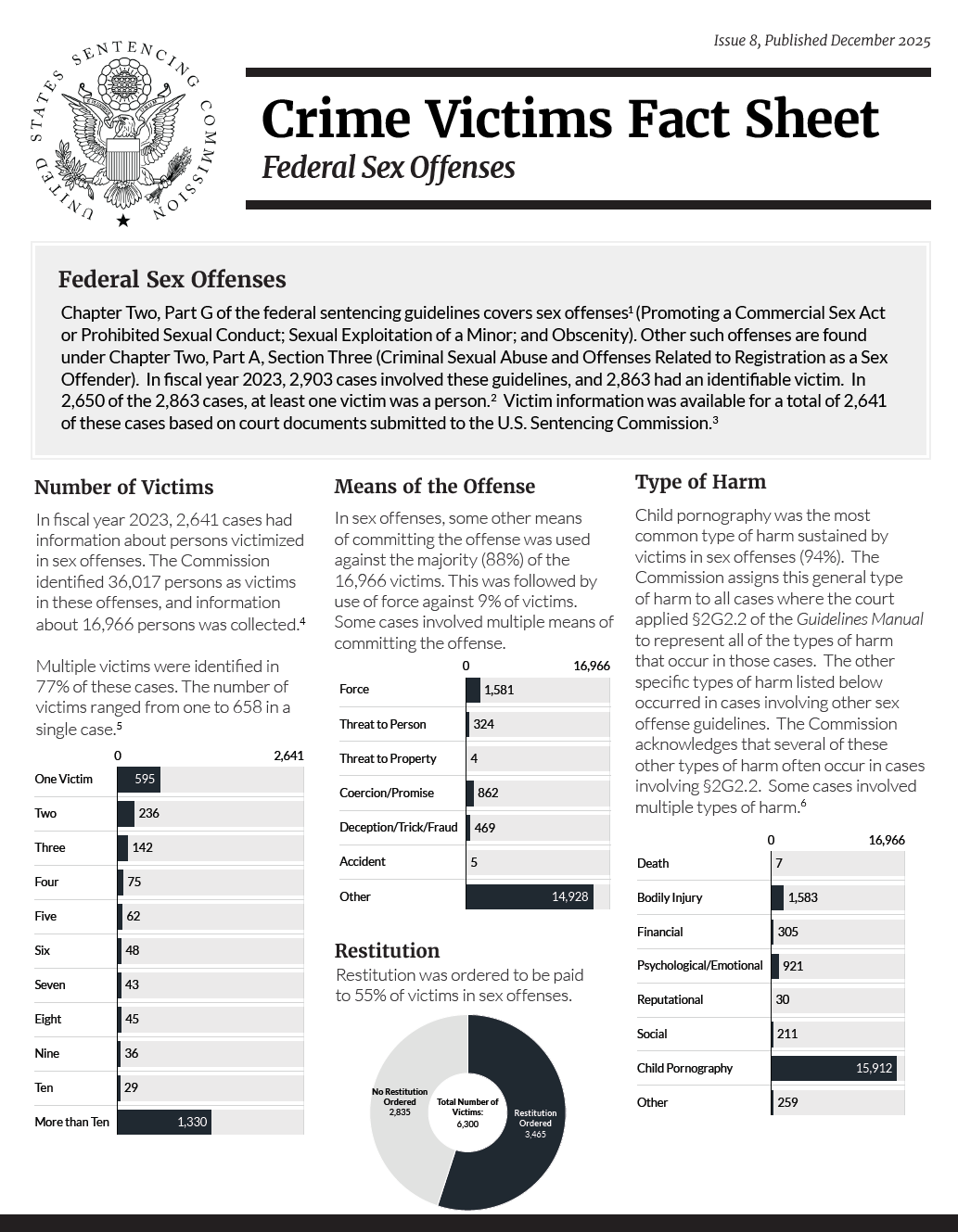
In fiscal year 2023, 2,641 cases had information about persons victimized in sex offenses. The Commission identified 36,017 persons as victims in these offenses, and information about 16,966 persons was collected.4
Multiple victims were identified in 77% of these cases. The number of victims ranged from one to 658 in a single case.5
MEANS OF THE OFFENSE
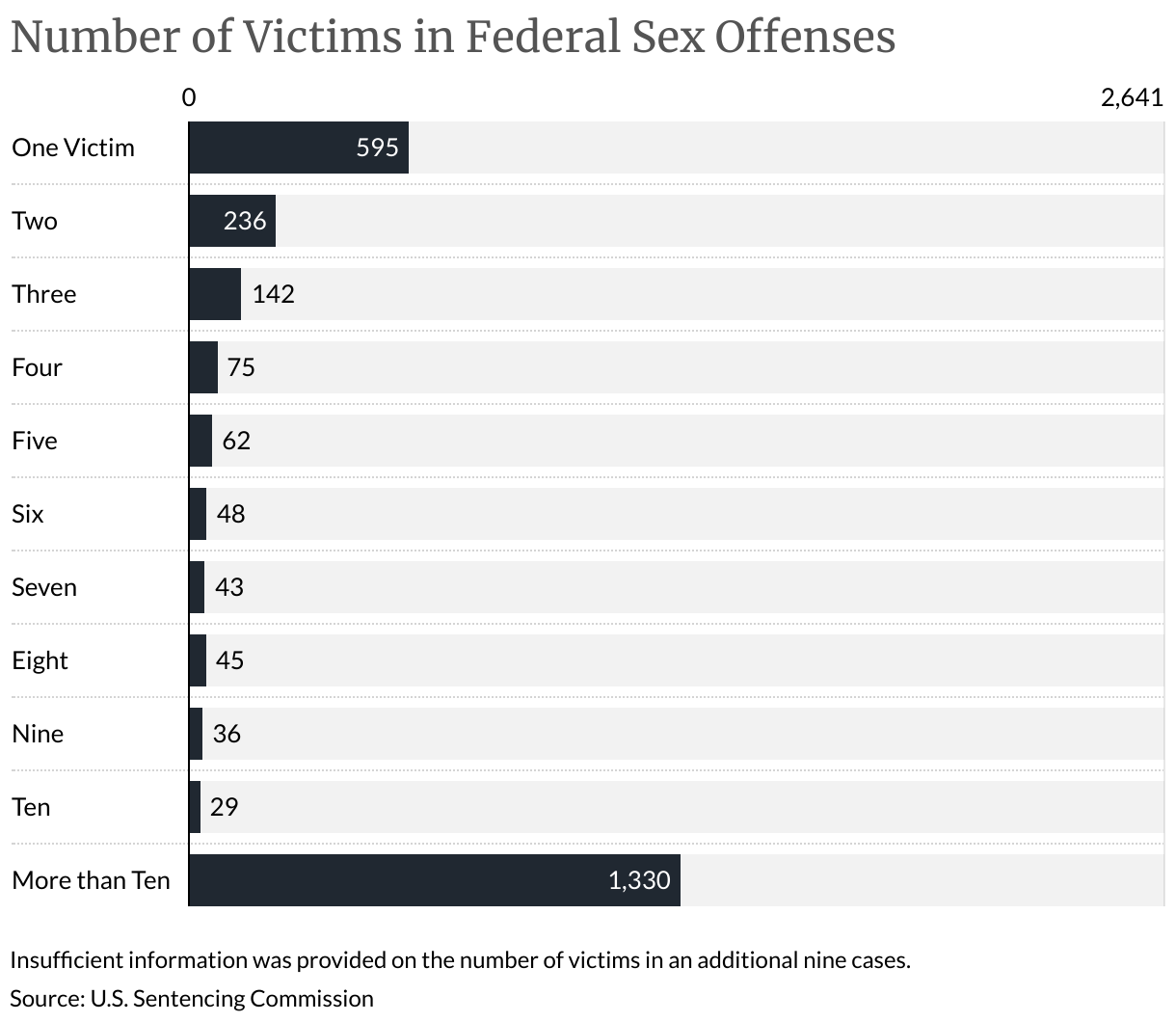
In sex offenses, some other means of committing the offense was used against the majority (88%) of the 16,966 victims. This was followed by use of force against 9% of victims. Some cases involved multiple means of committing the offense.
TYPE OF HARM
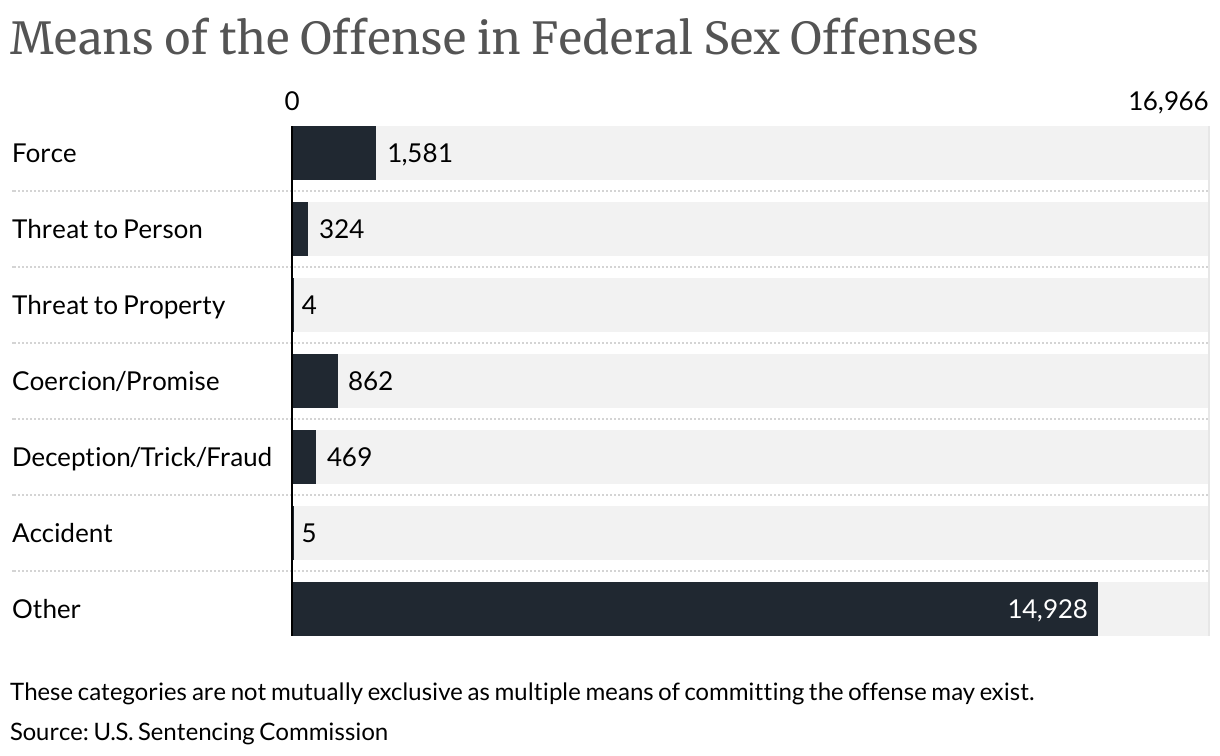
Child pornography was the most common type of harm sustained by victims in sex offenses (94%). The Commission assigns this general type of harm to all cases where the court applied §2G2.2 of the Guidelines Manual to represent all of the types of harm that occur in those cases. The other specific types of harm listed below occurred in cases involving other sex offense guidelines. The Commission acknowledges that several of these other types of harm often occur in cases involving §2G2.2. Some cases involved multiple types of harm.6
RESTITUTION
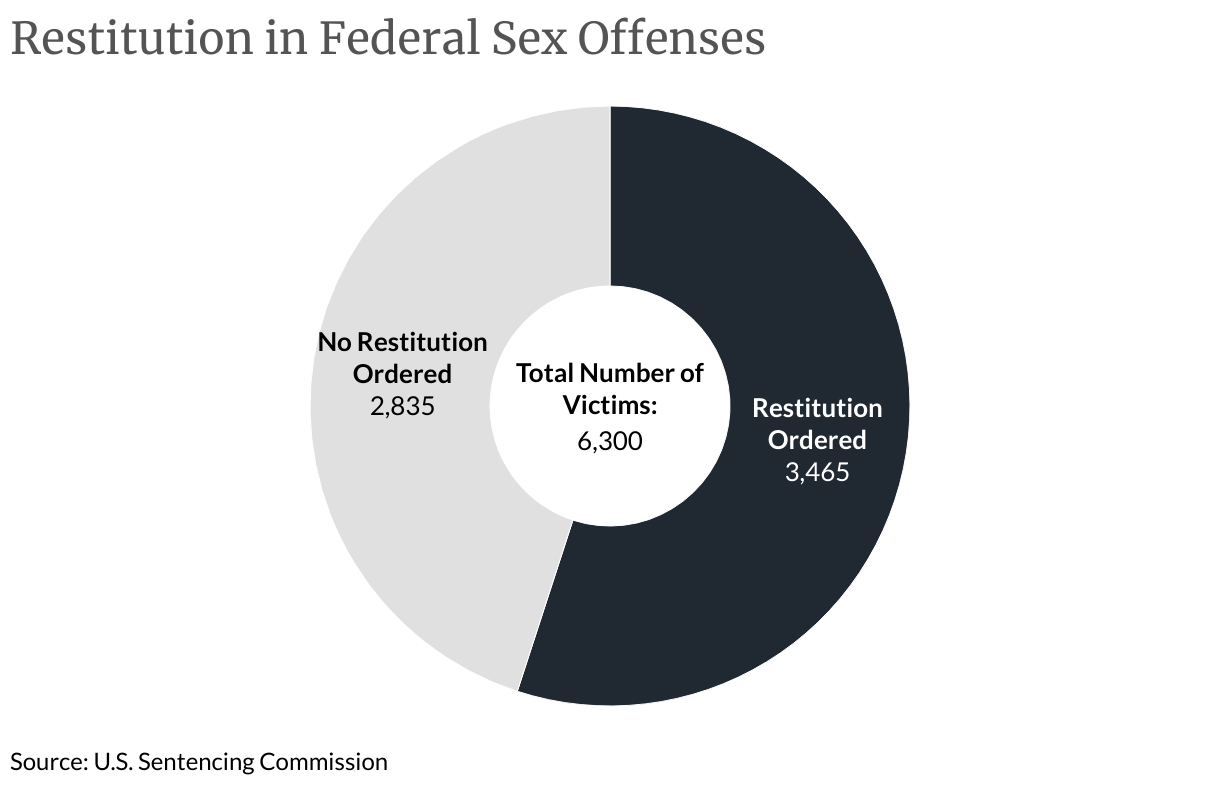
Restitution was ordered to be paid to 55% of victims in sex offenses.
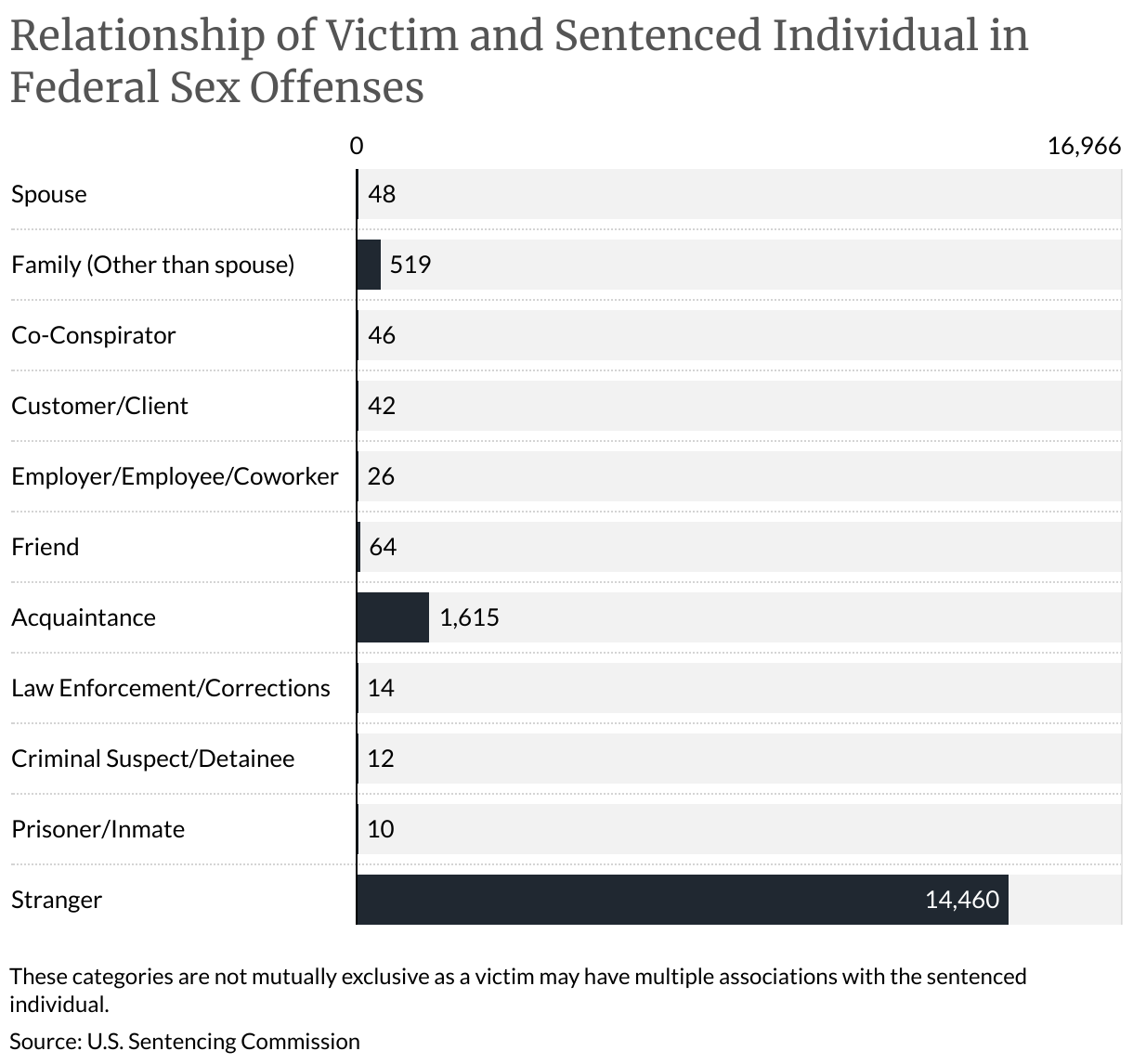
RELATIONSHIPS BETWEEN VICTIMS AND INDIVIDUALS WHO CAUSED HARM
In sex offenses, the most common association between victims and the individuals who caused them harm was as a stranger (85%). The next most common was as an acquaintance (10%). Some cases involved multiple relationship types.
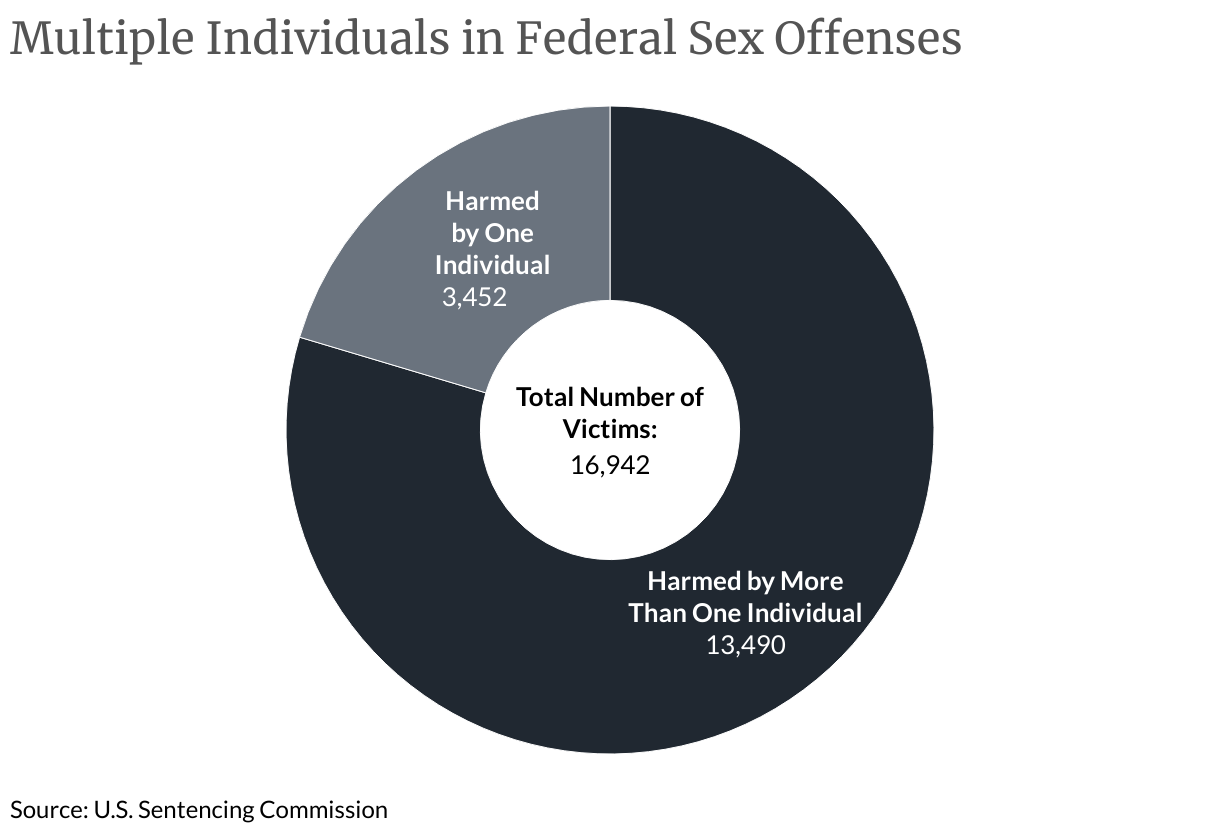
80% of victims in sex offenses were harmed by more than one individual.
VULNERABILITY
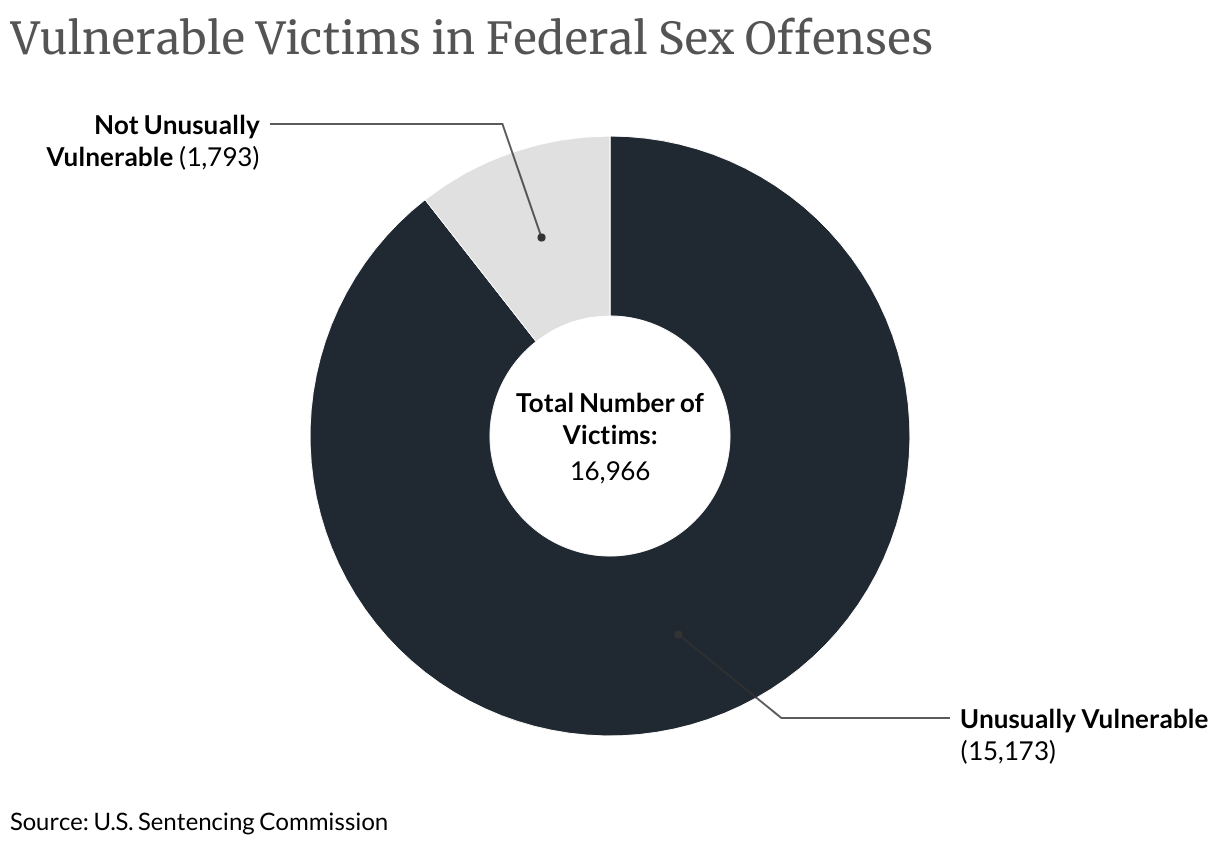
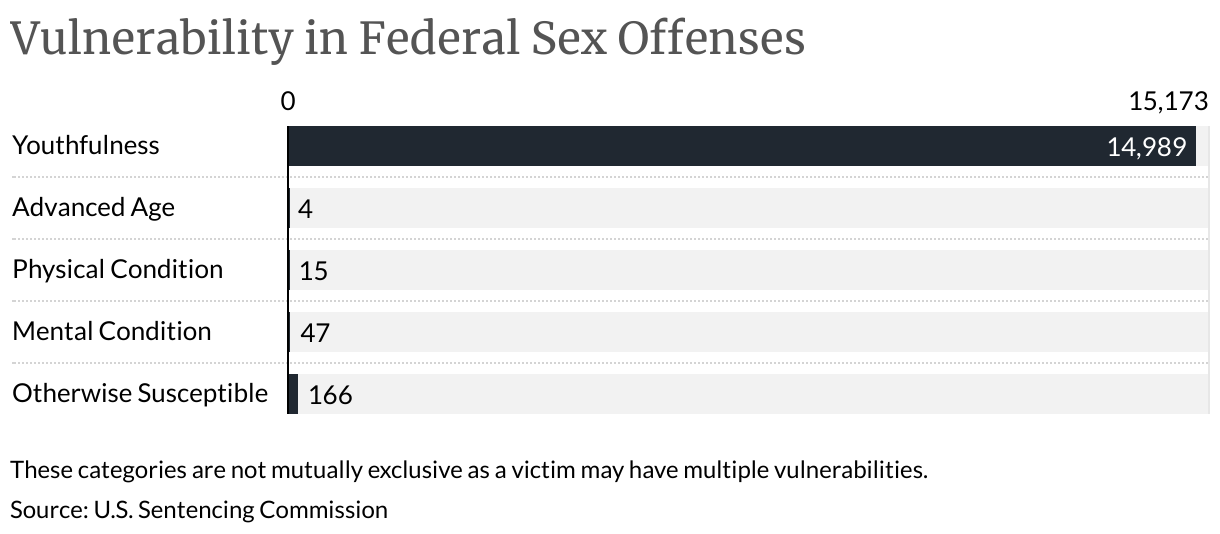
Most sex offenses involved victims who were unusually vulnerable due to age, physical or mental condition, or other factors.7 The Commission identified 89% of victims in these cases as unusually vulnerable for one of these reasons.
VICTIM CHARACTERISTICS
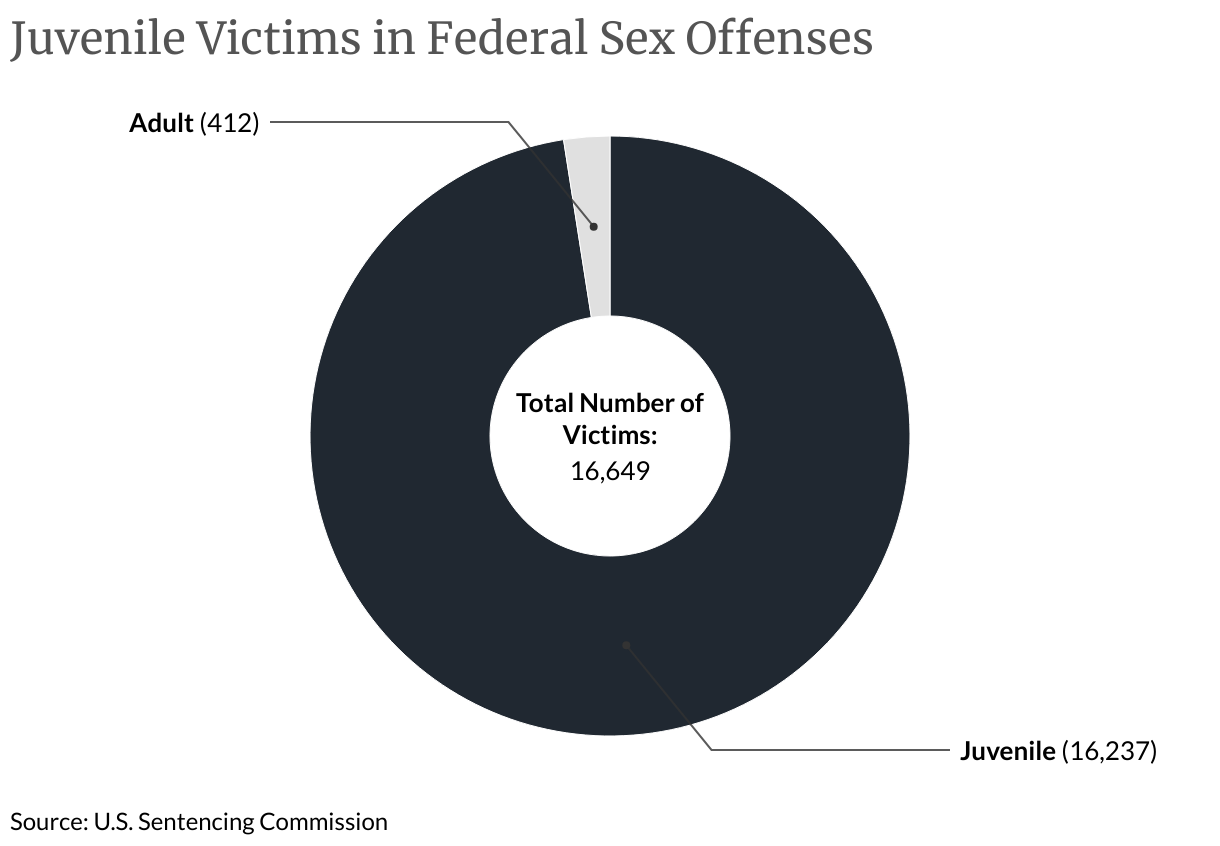
Almost all (98%) victims in sex offenses were juveniles.
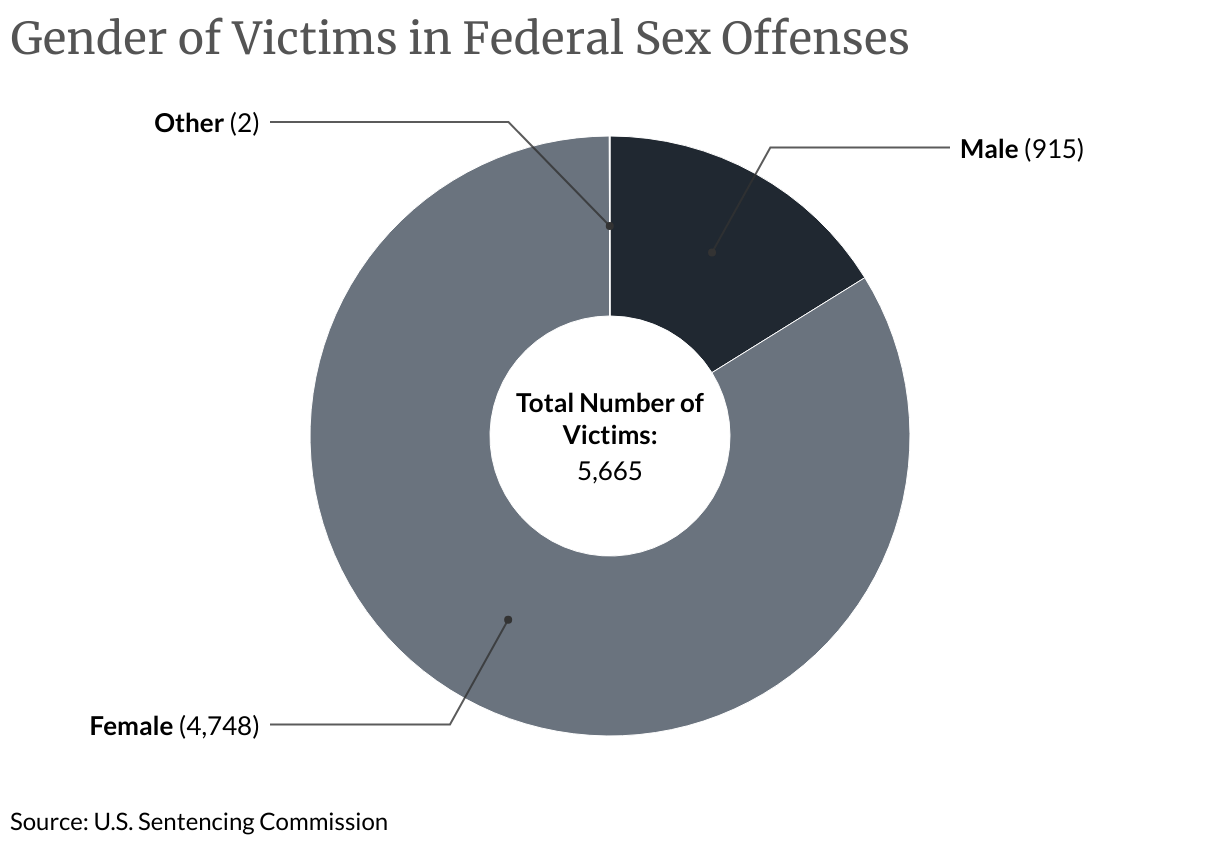
The majority (84%) of victims in sex offenses were female.
ENDNOTES
1 Federal Offenses Involving Sex Offenses include individuals sentenced in fiscal year 2023 in cases involving USSG §§2A3.1 (Criminal Sexual Abuse; Attempt to Commit Criminal Sexual Abuse); 2A3.2 (Criminal Sexual Abuse of a Minor Under the Age of Sixteen Years (Statutory Rape) or Attempt to Commit Such Acts); 2A3.3 (Criminal Sexual Abuse of a Ward or Attempt to Commit Such Acts); 2A3.4 (Abusive Sexual Contact or Attempt to Commit Abusive Sexual Contact); 2A3.5(b) (Failure to Register as a Sex Offender); 2G1.1 (Promoting a Commercial Sex Act or Prohibited Sexual Conduct with an Individual Other Than a Minor); 2G1.3 (Promoting a Commercial Sex Act or Prohibited Sexual Conduct with a Minor; Transportation of Minors to Engage in a Commercial Sex Act or Prohibited Sexual Conduct; Travel to Engage in Commercial Sex Act or Prohibited Sexual Conduct with a Minor; Sex Trafficking of Children; Use of Interstate Facilities to Transport Information about a Minor); 2G2.1 (Sexually Exploiting a Minor by Production of Sexually Explicit Visual or Printed Material; Custodian Permitting Minor to Engage in Sexually Explicit Conduct; Advertisement for Minors to Engage in Production); 2G2.2 (Trafficking in Material Involving the Sexual Exploitation of a Minor; Receiving, Transporting, Shipping, Soliciting, or Advertising Material Involving the Sexual Exploitation of a Minor; Possessing Material Involving the Sexual Exploitation of a Minor with Intent to Traffic; Possessing Material Involving the Sexual Exploitation of a Minor); 2G2.3 (Selling or Buying of Children for Use in the Production of Pornography); 2G2.6 (Child Exploitation Enterprises); 2G3.1 (Importing, Mailing, or Transporting Obscene Matter; Transferring Obscene Matter to a Minor; Misleading Domain Names); or a conviction under 18 U.S.C. § 2260A with a mandatory minimum. Multiple sentencing guidelines may have been applied in these cases, including some not listed above.
2 An identifiable victim can be a person, business, government, or other type. This series provides victim information on persons.
3 The Commission’s Crime Victims Fact Sheets series relies on information collected and analyzed through a special coding project undertaken by the Commission to gather information beyond what is regularly collected and reported on by the Commission.
4 The sentencing documents received from the courts by the Commission are often focused on the sentencing event; therefore, some information regarding the victims of the offense was not provided in the documents available for staff review. For this reason, the total number of cases with complete information, and the corresponding number of victims in those cases, will vary by analysis. Victim information was collected for the first ten persons documented in the records.
5 Cases involving USSG §2G2.2 often have an indeterminable number of victims. In these cases, the Commission has set the number of victims at 11.
6 In a small number of cases, the type of harm resulted from additional counts of conviction for offenses other than the ones discussed in this fact sheet. All of the harm types involved in a case are reported in this fact sheet.
7 In some, but not all, of these cases the court applied the adjustment at USSG §3A1.1. Vulnerability due to advanced age or youthfulness was determined by the offense conduct stated in the presentence investigation report adopted by the court, and not based on any minimum or maximum age.
SOURCE: U.S. Sentencing Commission, 2023 Victim Datafile, VICFY23.