
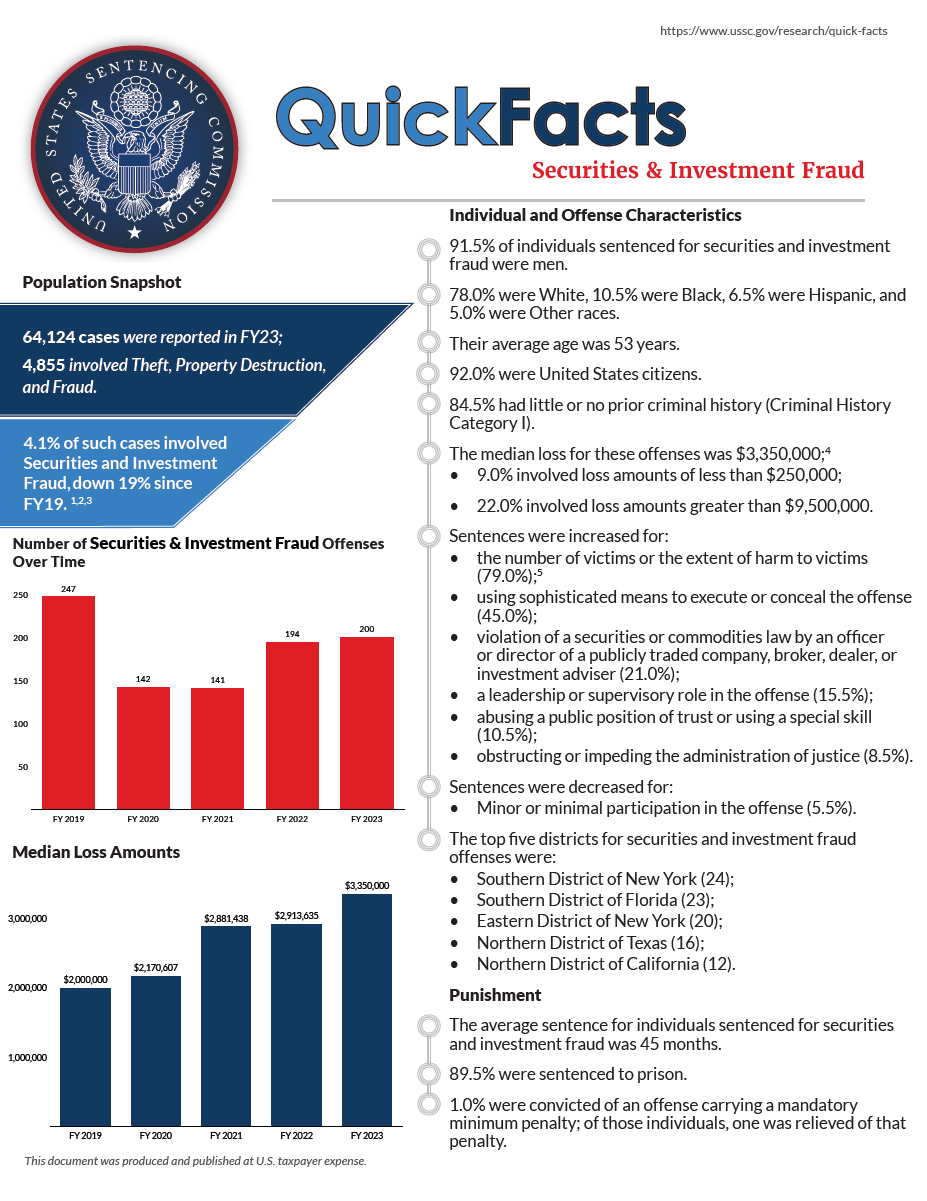
Of the 66,662 cases reported to the Commission in fiscal year 2025, 202 involved securities and investment fraud.1,2 Securities and investment fraud offenses have increased 43% since fiscal year 2021.
Click the cover for the PDF handout or learn more below.
Individual and Offense Characteristics

- 94% of individuals sentenced for securities and investment fraud were men.
- 71% were White, 13% were Hispanic, 9% were Other races, and 6% were Black.
- Their average age was 51 years.
- 84% were United States citizens.
- 86% had little or no prior criminal history (Criminal History Category I).
- The median loss for these offenses was $3,741,264;3
- 6% involved loss amounts of less than $250,000;
- 30% involved loss amounts greater than $9,500,000.
- Sentences were increased for:
- the number of victims or the extent of harm to victims (80%);4
- using sophisticated means to execute or conceal the offense (47%);
- violation of a securities or commodities law by an officer or director of a publicly traded company, broker, dealer, or investment adviser (15%);
- a leadership or supervisory role in the offense (17%);
- abusing a public position of trust or using a special skill (17%);
- obstructing or impeding the administration of justice (16%).
- Sentences were decreased for:
- minor or minimal participation in the offense (3%).
- minor or minimal participation in the offense (3%).
- The top six districts for securities and investment fraud offenses were:
- Southern District of New York (33);
- Eastern District of New York (24);
- District of New Jersey (12);
- Northern District of Ohio (11);
- Eastern District of Pennsylvania (10);
- Nothern District of Illinois (10).

Punishment
- The average sentence for individuals sentenced for securities and investment fraud was 51 months.
- 89% were sentenced to prison.
- 3% were convicted of an offense carrying a mandatory minimum penalty; 29% of those individuals were relieved of that penalty.
Sentences Relative to the Guideline Range
- 52% of sentences for securities and investment fraud were under the Guidelines Manual.
- 25% were within the guideline range.
- 24% were substantial assistance departures.
- The average sentence reduction was 78%.
- The average sentence reduction was 78%.
- Less than 1% were Early Disposition Program (EDP) Departures.5,6
- 2% were some other downward departure.
- The average sentence reduction was 50%.
- The average sentence reduction was 50%.
- 1% were upward departures.
- 25% were within the guideline range.
- 48% of sentences for securities and investment fraud were variances.
- 43% were downward variances.
- The average sentence reduction was 49%.
- The average sentence reduction was 49%.
- 4% were upward variances.
- The average sentence increase was 57%.
- 43% were downward variances.


- The average guideline minimum and average sentence imposed have fluctuated over the past five years.
- The average guideline minimum increased and decreased throughout the fiscal years. The average guideline minimum was 79 months in fiscal year 2021 and 88 months in fiscal year 2025.
- The average guideline minimum increased and decreased throughout the fiscal years. The average sentence imposed was 51 months in fiscal year 2021 and fiscal year 2025.
- The average guideline minimum increased and decreased throughout the fiscal years. The average guideline minimum was 79 months in fiscal year 2021 and 88 months in fiscal year 2025.

1 Securities and investment fraud includes cases in which the individual was sentenced under §2B1.1 (Larceny, Embezzlement, and Other Forms of Theft; Offenses Involving Stolen Property; Property Damage or Destruction; Fraud and Deceit; Forgery; Offenses Involving Altered or Counterfeit Instruments Other than Counterfeit Bearer Obligations of the United States) using a Guidelines Manual in effect on November 1, 2001 or later and where the offense conduct as described in the Presentence Report involved the deception of investors or the manipulation of financial markets.
2 Cases with incomplete sentencing information were excluded from the analysis.
3 The Loss Table was amended effective November 1, 2001 and November 1, 2015.
4 The Victims Table and Sophisticated Means adjustment were amended effective November 1, 2015.
5 The Commission does not report the average for categories with fewer than three cases.
6 "Early Disposition Program” (or EDP) departures are departures where the government sought a sentence below the guideline range because the defendant participated in the government’s Early Disposition Program, through which cases are resolved in an expedited
manner. See USSG §5K3.1.
SOURCE: United States Sentencing Commission, FY 2021 through FY 2025 Datafiles, USSCFY21-USSCFY25.