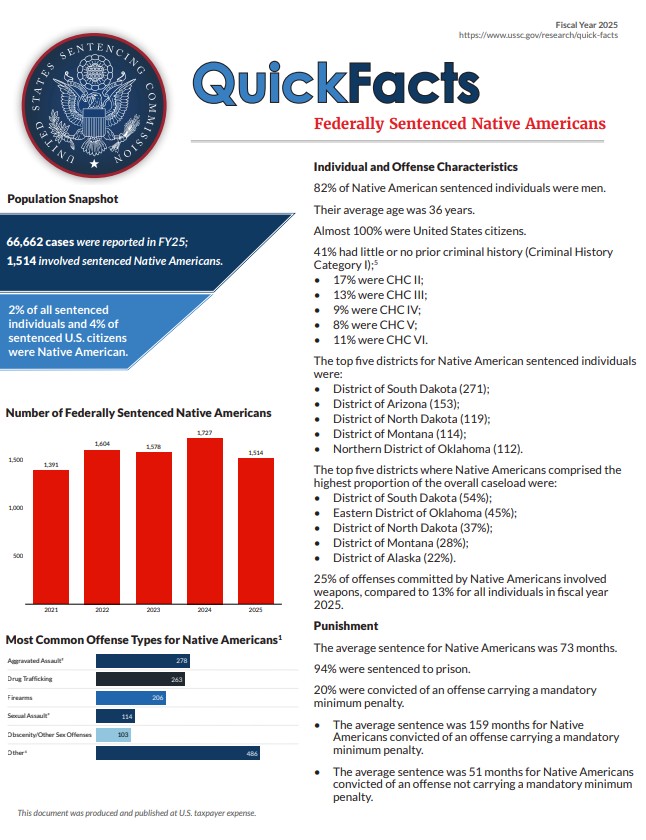
Of the 66,662 cases reported to the Commission in fiscal year 2025, 1,514 involved Native American sentenced individuals. Native Americans accounted for 2% of all federally sentenced individuals and 4% of federally sentenced U.S. citizens in fiscal year 2025.
Click the cover for the PDF handout or learn more below.
Individual and Offense Characteristics


- 82% of Native American sentenced individuals were men.
- Their average age was 36 years.
- Almost 100% were United States citizens.
- 41% had little or no prior criminal history (Criminal History Category I):5
- 17% were CHC II;
- 13% were CHC III;
- 9% were CHC IV;
- 8% were CHC V;
- 11% were CHC VI.
- The top five districts for Native American sentenced individuals were:
- District of South Dakota (271);
- District of Arizona (153);
- District of North Dakota (119);
- District of Montana (114);
- Northern District of Oklahoma (112).
- The top five districts where Native Americans comprised the highest proportion of the overall caseload were:
- District of South Dakota (54%);
- Eastern District of Oklahoma (45%);
- District of North Dakota (37%);
- District of Montana (28%);
- District of Alaska (22%).
- 25% of offenses committed by Native Americans involved weapons, compared to 13% of all offenses in fiscal year 2025.
Punishment
- The average sentence for Native Americans was 73 months.
- 94% were sentenced to prison.
- 20% were convicted of an offense carrying a mandatory minimum penalty.
- The average sentence was 159 months for Native Americans convicted of an offense carrying a mandatory minimum penalty.
- The average sentence was 51 months for Native Americans convicted of an offense not carrying a mandatory minimum penalty.
Sentences Relative to the Guideline Range
- 60% of sentences for Native Americans were under the Guidelines Manual.
- 42% were within the guideline range.
- 8% were substantial assistance departures.
- The average sentence reduction was 57%.
- The average sentence reduction was 57%.
- 2% received an Early Disposition Program (EDP) departure.6
- The average sentence reduction was 65%.
- The average sentence reduction was 65%.
- 5% were some other downward departure.
- The average sentence reduction was 42%.
- 3% were upward departures.
- The average sentence increase was 86%.
- The average sentence increase was 86%.
- 42% were within the guideline range.
- 40% of sentences for Native Americans were variances.
- 34% were downward variances.
- The average sentence reduction was 45%.
- The average sentence reduction was 45%.
- 6% were upward variances.
- The average sentence increase was 79%.
- 34% were downward variances.


- The average guideline minimum and average sentence imposed have increased over the past five years.
- The average guideline minimum increased from 67 months in fiscal year 2021 to 81 months in fiscal year 2025.
- The average sentence imposed increased from 56 months in fiscal year 2021 to 73 months in fiscal year 2025.
- The average guideline minimum increased from 67 months in fiscal year 2021 to 81 months in fiscal year 2025.

1 Cases with incomplete sentencing information were excluded from the analysis.
2 Aggravated assault includes cases where the court applied §2A2.2 as the primary sentencing guideline.
3 Sexual assault includes cases where the court applied §§2A3.1, 2A3.2, 2A3.3, or 2A3.4 as the primary sentencing guideline.
4 “Other” guidelines include Manslaughter (72) and Murder (64). No other guideline had a value greater than 50.
5 Tribal offenses are not counted in determining the criminal history score under the sentencing guidelines. See §4A1.2(i).
6 Early Disposition Program” (or EDP) departures are departures where the government sought a sentence below the guideline range because the defendant participated in the government’s Early Disposition Program, through which cases are resolved in an expedited manner. See USSG §5K3.1.
SOURCE: United States Sentencing Commission, FY 2021 through FY 2025 Datafiles, USSCFY21-USSCFY25.